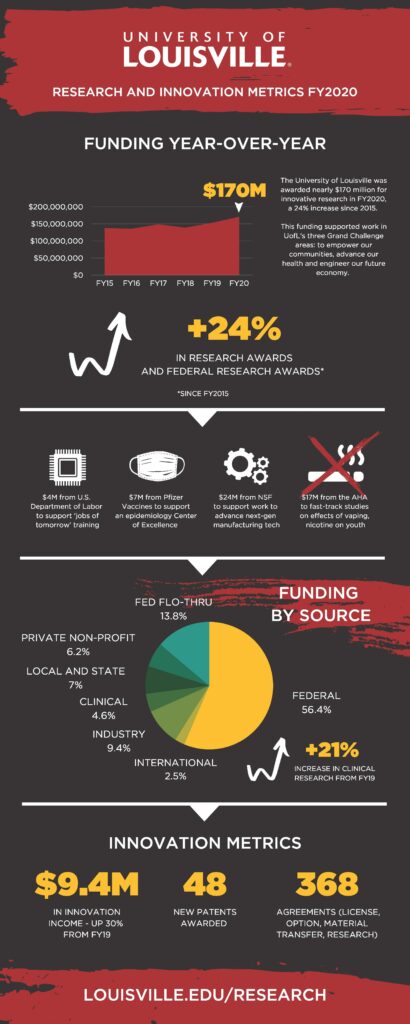
LOUISVILLE, Ky. 鈥� The University of Louisville secured nearly $170 million to support groundbreaking research in the 2019-2020 fiscal year 鈥� the university鈥檚 most successful year ever for competitively funded research.
That funding, an increase of nearly $18 million over the previous record year in fiscal 2018-2019, supported work to train students for the technology-backed 鈥渏obs of tomorrow,鈥� to research and test vaccines as a Pfizer Vaccines Center of Excellence and to develop next-generation manufacturing technology.
鈥淥ne of our goals at UofL is to be a great place to invest,鈥� said UofL President Neeli Bendapudi, Ph.D. 鈥淭his is proof-positive that we are succeeding in that goal 鈥� that UofL and its research are a strong investment. The work this funding supports has the potential to address the grand challenges of our time: how we empower communities, advance health and engineer the future of work.鈥�
Kevin Gardner, Ph.D., UofL鈥檚 executive vice president for research and innovation, said that investment value is especially apparent in the university鈥檚 work over the past year to combat the COVID-19 global pandemic through research that illuminates the virus鈥檚 spread, possible treatments and .

鈥淭he research we do here at UofL has impact 鈥� huge impact 鈥� and can improve dramatically the way we live and work,鈥澛燝ardner said. 鈥淥ur continued success in securing funding is a testament to the dedication of our faculty and staff to supporting that important, potentially world-changing research.鈥�
The 2019-2020 fiscal year also was the university鈥檚 best year on record for commercialization income, according to the , an office of UofL Research and Innovation that works with industry and startups to commercialize university technologies. UofL earned $9.4 million from license royalties and other related income, a 30-percent increase over the year prior.
The increased income was propelled by a strong year of deals and startups, with seven companies launched. Those startups include BioProducts, a new company commercializing a university technology for producing , and Unitonomy, which is commercializing a tool for measuring employee engagement. Deals included the licensing of a technology believed to , from infecting human cells.
鈥淚t鈥檚 important for people to know that our research doesn鈥檛 end with a manuscript, but with getting our research out into the world where it can have real impact,鈥� Gardner said.
#WeAreUofL